
Hamburg – continuation of the BiDiMoVe project
- Articles and technical information
- Press releases
In August 2021, we successfully took part in the BiDiMoVe project plug test (Bidirektionale Multimodale Vernetzung – a project funded by the German Federal Ministry of Transport and Digital Infrastructure) – more here – held as part of the ITS World Congress 2021. And we were the only ones to ‘integrate’ direct communication between Trapeze’s on-board computer and our OBU (On-Board Unit) – type UCU 5.0V – using the IBIS PLUS protocol, and on this basis we implemented public transport priority.
Background:
Now, following our successful plug tests in 2021, as part of the ongoing BiDiMoVe project in Hamburg, our OBU unit has been installed on a Hamburger Hochbahn bus. It currently provides priority at 9 junctions equipped with RSU units from Swarco and Yunex. The unit is successfully connected to a Trapeze on-board computer.
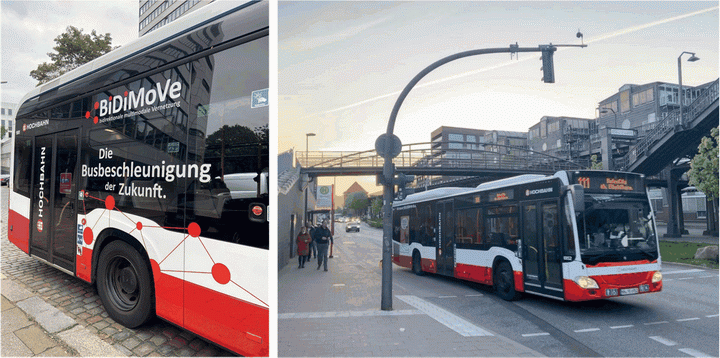
The project has the following key features:
- Public transport priority via SREM and SSEM messages
- SREM messages are processed by a central system
- SREM messages are received by RSU units from manufacturers Swarco/Yunex and correctly responded to with SSEM messages
- Secure communication – the unit is registered in the BiDiMoVe PKI, provided by Escrypt.
- The OBU unit is connected to the on-board computer via the IBISPlus protocol. This provides it with an overview of stops, the route, the service number and current delays (SOAP interface).
Priority control method:
Unlike the public transport priority system operated by DPMB a.s. (Brněnské komunikace a.s.), within the BiDiMoVe project the SREM message does not focus on a specific junction (support for local control versus support for central control). Instead, it is sent to all RSUs in the vicinity. The SREM message contains details of the current journey – e.g. route number, next stop and delay. The RSU unit at the junction forwards the SREM message containing the above information to the central system. Upon receiving the priority request, the central system generates a response to the RSU, which then generates an SSEM message, and this is received by the OBU unit on the vehicle.
Possibility of using a signal plan:
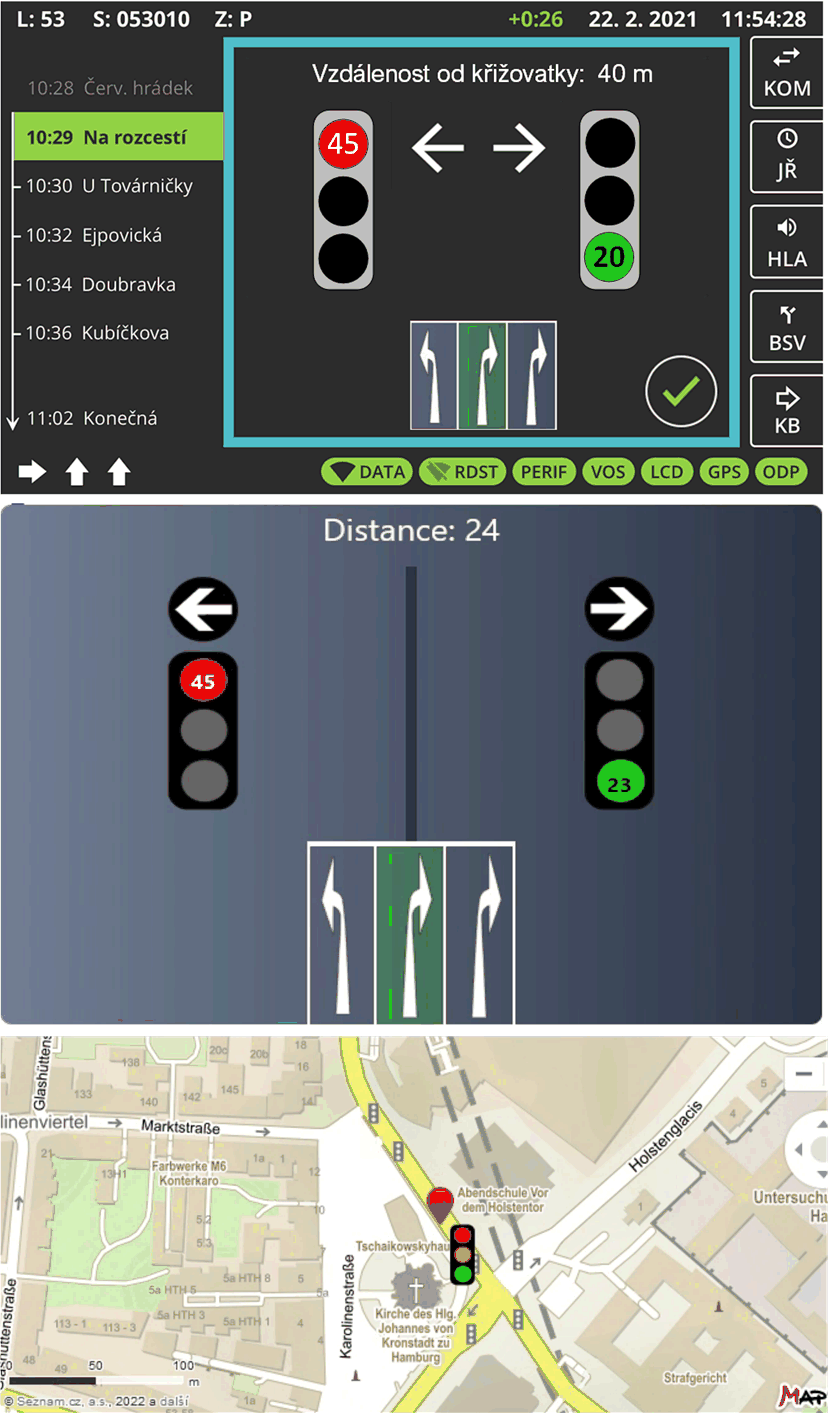 V2X communication also enables many other services besides public transport priority. The city of Hamburg is investing heavily in this system to ensure it has a fully functional and comprehensive C-ITS system. When a vehicle with our OBU travels through the city, it receives various V2X messages. For example, it correctly processes messages containing junction topology (MAPEM) and the traffic light controller’s signal plan (SPATEM). The result is shown on the right: the OBU has correctly located itself in the junction lane (green-highlighted arrow) and is able to display the time until the green light:
- Top image – a possible display on our EPIS 4.0 or EPIS 5.0 in-vehicle unit, where a warning to proceed appears on the in-vehicle unit upon approaching the junction. The driver can thus adjust their speed to drive economically and, if necessary, dismiss the display.
- Middle image – this is a visualisation from the UCU BOS software, which is designed for managing OBU and RSU units, and which reads this information directly from the OBU unit on the vehicle and can display it to the software operator.
- Bottom image – this is a real-life situation showing a public transport bus passing through an intersection in Hamburg, as depicted in the middle image (currently displayed on the map.cz platform). It clearly shows how the vehicle is approaching the intersection.
Applying experience from the RIS II project:
We are currently preparing a solution for the transition from the original public transport priority systems at Hamburg Verkehrsanlagen. It is inspired by the solution for the transition of priority systems at DPMB (RIS II project), i.e. we are preparing a so-called ‘transitional’ RSU. This means that its aim is to give priority to public transport and emergency vehicles (based on our experience from Ústí and Brno) on an older traffic light controller – a controller that does not support V2X. In this way, we can assist during the transition phase from analogue radio to V2X.