
MetroBus Porto – a project based on V2X technology
- News
- Articles
At the end of February, the 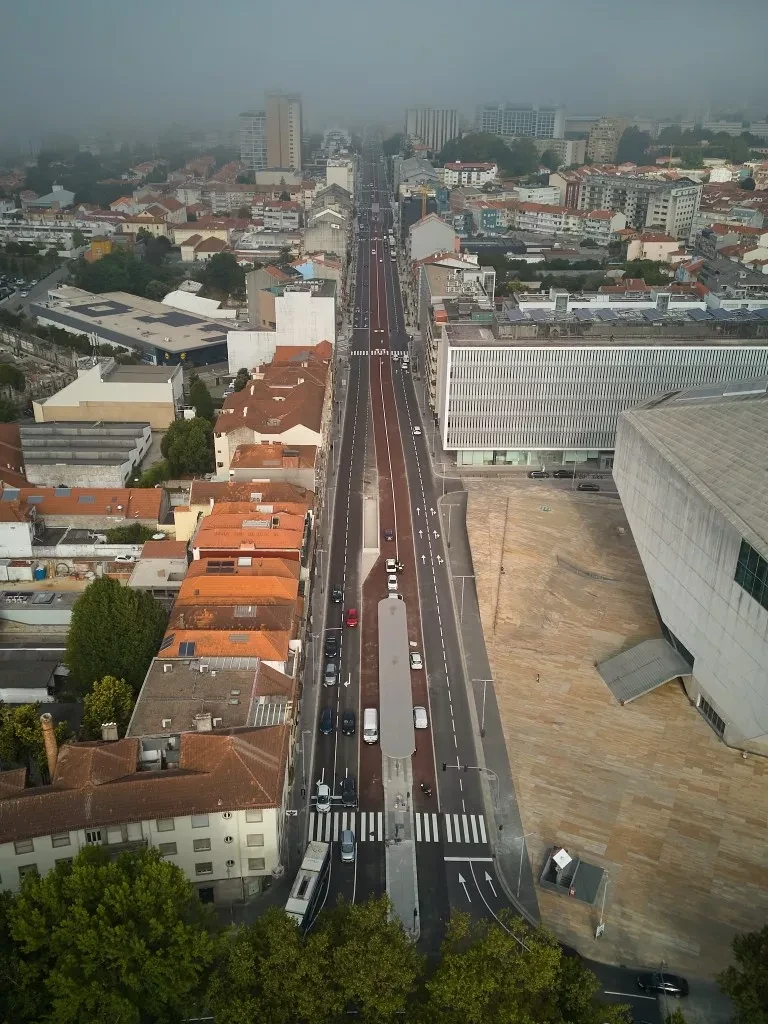 Portuguese city of Porto launched a new Bus Rapid Transit (BRT) system based on hydrogen-powered articulated buses, known as MetroBus. The project represents one of the most advanced examples of zero-emission urban transport in Europe and is also the world’s first OEM-led hydrogen-powered BRT system.
Herman contributed to the project by supplying V2X (Vehicle-to-Everything) technology to give vehicles priority at junctions, which is a key component of the operational concept and enables MetroBus vehicles to behave more like rail transport than conventional buses in urban traffic.
MetroBus Porto: A new-generation BRT system
The MetroBus system is based on 18-metre Caetano H2.CityGold articulated buses powered by fuel cells, developed in collaboration with Toyota. The vehicles are designed for operation on dedicated infrastructure with central platforms; they offer a capacity of up to 135 passengers and enable fully emission-free operation with a long range and short hydrogen refuelling times.
The first MetroBus route runs for approximately 3.9 km along Avenida da Boavista, connecting the Casa da Música multimodal hub with the Praça do Império area. The entire route is designed as a segregated corridor with an emphasis on smooth flow, punctuality and high throughput.
Photo © Metro do Porto on X, taken from Urban Transport Magazine, used with permission.
Why V2X technology is key
MetroBus Porto is not designed as a traditional bus route with passive priority, but as a system with actively managed priority, which is an integral part of its architecture. This is where V2X technology (C2X, V2I, C-ITS) plays a crucial role.
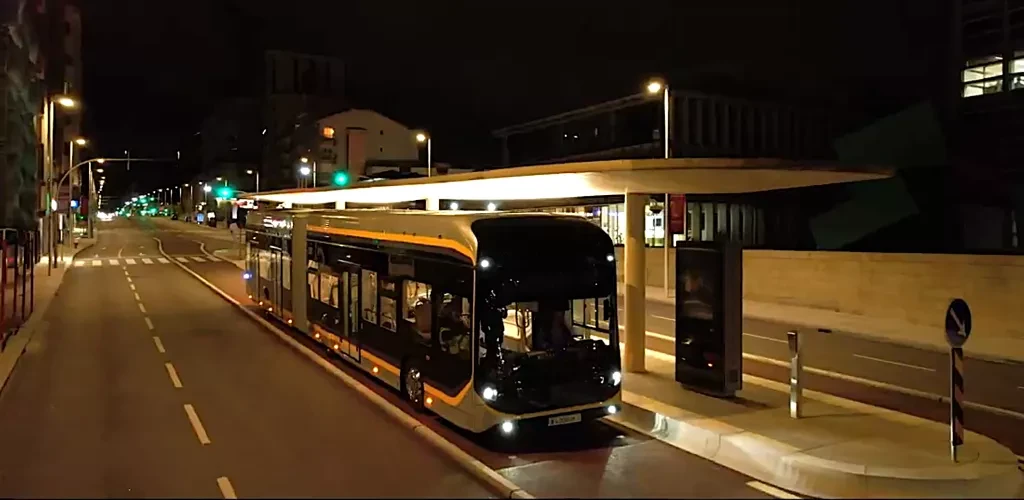
Photo © Metro do Porto, reproduced from Urban Transport Magazine, used with permission.
Thanks to V2X communication, vehicles are able to:
- communicate in real time with traffic-light-controlled junctions,
- transmit information on their position, speed and direction of travel,
- actively request permission to pass through a junction without having to stop.
Based on this data, the transport infrastructure ensures a clear passage, allowing MetroBus vehicles to pass through junctions smoothly, without having to wait for standard traffic light cycles.
On the transport infrastructure side, the priority system has been integrated in collaboration with the Portuguese company Soltráfego and the Czech company Cross.
The results are:
- Very short journey times, even in dense urban areas. The average journey time is 12 minutes, despite the fact that the vehicle passes through a total of over 26 controlled junctions with traffic lights.
- Stable and predictable journey times (priority is also ensured for vehicle turning manoeuvres)
- Operational behaviour comparable to that of trams or light rail.
Without V2X technology, it would be possible to operate the vehicles physically, but it would not be possible to meet the BRT system’s parameters, in particular the smooth passage through junctions and the stated operating speed. In addition to priority, other methods of speeding up trams were of course utilised, such as dedicated lanes. Without priority, however, such a speed of passage would not be possible. C-ITS thus becomes one of the pillars of modern urban transport.
Open architecture
International and open communication standards are used not only for V2X communication (C-ITS / C-ROADS standards), but also for data transfer between the vehicle’s on-board computer and the OBU unit. The ITxPT standard is used here. The entire system architecture is therefore based as far as possible on open protocols, which ensures seamless future development for the operator.
A benchmark project for modern cities
MetroBus Porto forms part of the city’s broader strategy aimed at decarbonising transport and developing intelligent transport systems. The project combines zero-emission vehicles, green hydrogen production and advanced traffic management into a single integrated solution.
Herman’s involvement in this project underscores its expertise in cooperative intelligent transport systems (C-ITS) and the implementation of V2X (C2X, C-ITS) in real-world urban traffic, including for critical, fail-safe applications. V2X technology thus proves that it is entirely reliable for urban use and has long since moved beyond the pilot project stage.
At the same time, this is the first BRT project in Europe to be based on C-ITS technology.