
Public transport control systems in Zlín and Otrokovice
- News
New-generation on-board computers, C-ITS communication, the TETRA digital radio network, communication infrastructure at the depot and a modern control centre system. In Zlín and Otrokovice, we have implemented a comprehensive technological solution that connects public transport vehicles with the control centre, the operator’s facilities and the city’s transport infrastructure.
For the Zlín-Otrokovice Transport Company, we have carried out an extensive modernisation of the digital control system for public transport vehicles. The project integrates in-vehicle technology with the transport infrastructure, the operator’s technical facilities and the control centre.
A new generation of on-board system
The vehicle component of the solution is based on the EPC 4.1 on-board computer, supplemented by the new version of the EPT 4.08F driver’s touchscreen terminal.
The on-board computer functions as the central control unit of the vehicle information system and links information and ticketing systems, radio communication, C-ITS and other vehicle technologies.
Thanks to C-ITS integration, selected information can be relayed to the driver. For example, the on-board computer’s screen can display alerts regarding roadworks, an approaching integrated emergency service vehicle or other important traffic situations.
We also demonstrated this feature in practice at the Association of Transport Companies in Zlín, where we showed how selected C-ITS information is displayed directly on the on-board computer screen.
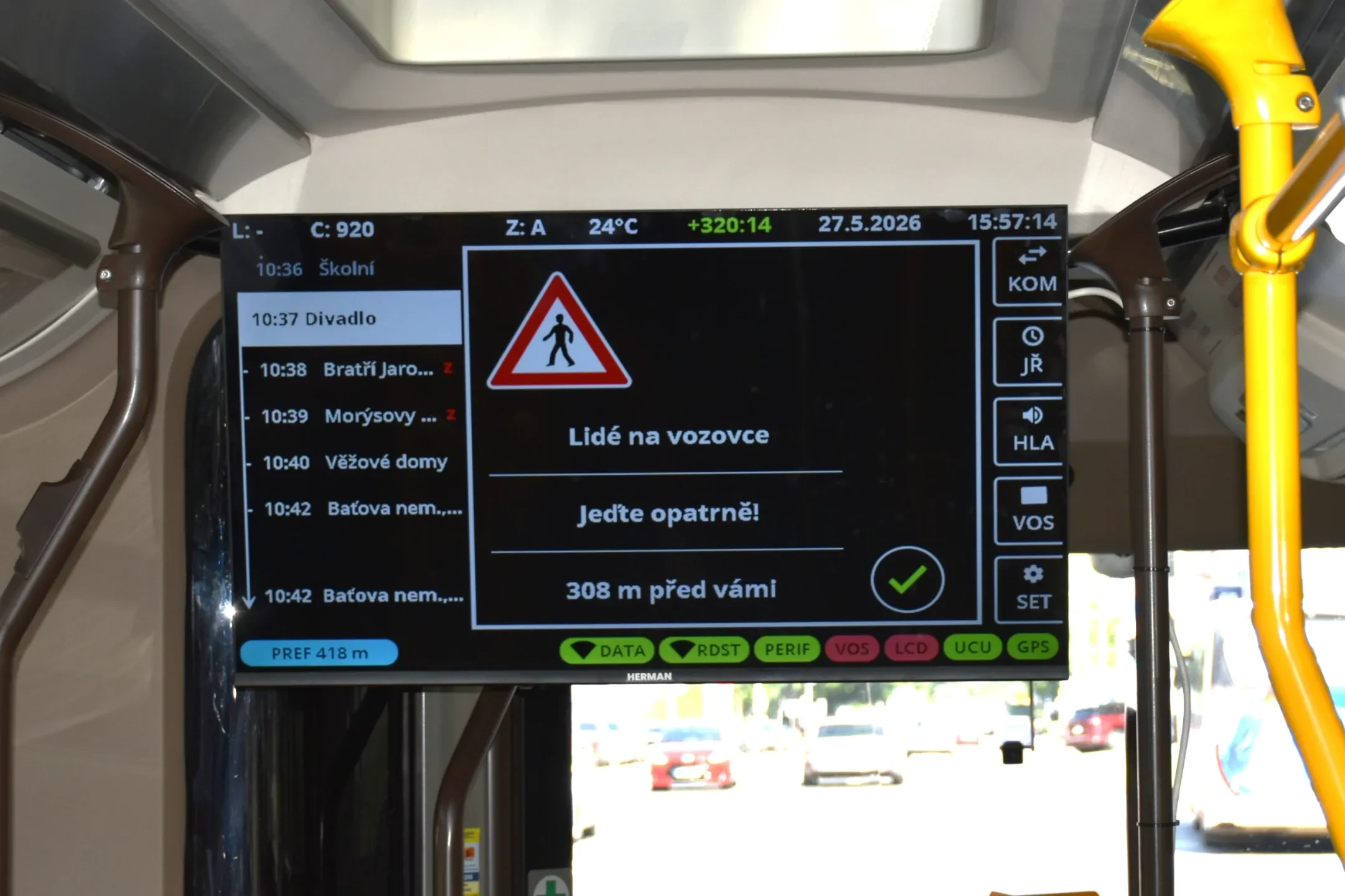
Mirroring the display of C-ITS messages from the in-car computer screen during a presentation at the Association of Transport Companies.
C-ITS connects vehicles with their surroundings
The solution also includes On-Board Units (OBUs) with enhanced communication capabilities. These enable the exchange of information with elements of the transport infrastructure as well as with other vehicles, thus forming a vital part of C-ITS communication.
C-ITS also enables public transport vehicles to be given priority at traffic-light-controlled junctions, thereby contributing to their smoother passage through the city.
The solution also includes the C-ITS Back Office ANBOS for the central management and monitoring of C-ITS units and the handling of C-ITS messages. The project thus builds on our [implementation of ITS in Zlín].
Independent TETRA digital radio communication
An important part of the modernisation is the TETRA digital radio network itself, which provides both voice and data connections between vehicles and the control centre.
Its key advantage is that operational communications are independent of public mobile networks. The transport operator thus uses its own communications infrastructure for key connections with vehicles and is not solely reliant on the availability of the public mobile network. This is particularly important in emergency situations or in the event of a failure or disruption to the public mobile network.
The radio network is connected to the on-board system and, in addition to voice communication, enables the transmission of location and other operational data. The entire communication architecture is further complemented by the public mobile data network.
Communication infrastructure at the depot
Communication with the vehicle does not end when it returns from its route. The project therefore also includes a communication infrastructure at the depot, which enables automated communication with parked vehicles.
This network can be used to transmit larger volumes of operational and service data, such as operational history, logs, data from on-board equipment or updates.
The solution also incorporates LoRa technology for remotely waking up a parked vehicle. This means the on-board system does not need to remain fully active at all times. If data needs to be transferred or an update carried out, the vehicle can be remotely woken up and the necessary communication initiated.
LoRa enables the vehicle to be remotely woken up, whilst the communication infrastructure at the depot ensures the subsequent data transfer.
Updates, data transfers and other maintenance operations can therefore take place whilst the vehicles are not in regular service.
Transportella as the dispatch control centre
On the control centre side, the entire system is complemented by Transportella.
The dispatch solution processes information received from the vehicles and provides a unified environment for monitoring and managing operations. It enables the management of vehicle locations, timetables, operational information and communication between vehicles and the control centre.
This gives the dispatcher an overview of the current operational situation and key data from individual vehicles, all in one place.
A single technological ecosystem
The implemented system covers the entire operational life cycle of a vehicle, from departure from the depot through service on the route and communication with the transport infrastructure, right through to return to the operator’s base, stabling, data transfer and remote management.
The individual technologies are not standalone elements, but work together as part of a single solution.
The project in Zlín and Otrokovice is thus a further testament to HERMAN’s ability to supply not only individual technologies, but above all to integrate them into a comprehensive solution for public transport.